Showing posts with label German Cities. Show all posts

Wednesday, December 21, 2011

Christmas Market in Regensburg, Germany

Now is the time for Christmas markets in Germany and in some other places in the world. I have been to some Christmas markets in Europe and I always love it. This year, I visited some of these markets in Germany and yes in Madrid, Spain also.

It was my second time to visit the Christmas market in Regensburg, Bavaria, Germany last Dec. 20, 2011. It is not so big compared to the one in Nuremberg but it is fine. Visiting have fun visiting it to. As usual you can find a lot of Christmas decors and ornaments, handmade items, toys, books, nutcrackers, variety of German foods and many others in any Christmas markets in Europe.

It is always good to see and to experience the custom and tradition of a certain place or country.

the Christmas Market in Regensburg, Germany during our visit last Dec. 20, 2011. You can see the towers of St. Peter's Cathedral in the background.

Christmas decors in one of the stalls in Regensburg.

Thursday, April 14, 2011

The Regensburg Cathedral in Bavaria, Germany

The Regensburger Dom or Regensburg Cathedral is a prime example of Gothic architecture in southern Germany. It is dedicated to St. Peter and considered to be the famous landmark of the city Regensburg in the state of Bavaria, Germany.


view of Regensburg Cathedral in the foreground the Donau or Danube River. taken during our visit last August 2010.

The Cathedral is also the burial place of important bishops, including Johann Michael von Sailer (1829-1832, memorial built by Konrad Eberhard in the south chancel), Georg Michael Wittmann (1832-1833, memorial also by Konrad Eberhard in the north chancel), and Archbishop Michael Buchberger (1927-1961, likewise in the north chancel). In the western part of the central nave stands a bronze memorial for the Prince-Bishop Cardinal Philipp Wilhelm (d. 1598), the brother of Duke Maximilian I of Bavaria. wikipedia

Sunday, January 16, 2011

My Euro Travel in Bamberg, Germany

Bamberg is a city located in Upper Franconia, Bavaria, Germany. This city was added to the list of UNESCO World Heritage last 1993. It is a historical city and was not destroyed by World War II. Bamberg also called a City of Creches, the Rome of Franconia and International Cultural Treasure. Another unique name given to Bamberg is Little Venice due to its location on the river Regnitz close to its confluence with the river Main.

Here are some images taken during our visit last October 2010.

the river Regnitz in Bamberg, Bavaria

The bridges connecting to the Old Town Hall. The building in front is the Rottmeisterhäuschen and at the back of this is the Old Town Hall.

The Old Town Hall, also known as the Island Town Hall, since it is located between the spans of two bridges...see that second image here.

Some of the main sights are:

* Cathedral (1237), with the tombs of emperor Henry II and Pope Clement II
* Alte Hofhaltung, residence of the bishops in the 16th and 17th centuries
* Neue Residenz, residence of the bishops after the 17th century
* Old Town Hall (1386), built in the middle of the Regnitz River, accessible by two bridges
* Klein-Venedig ("Little Venice"), a colony of picturesque fishermen's houses from the 19th century along one side of the river Regnitz.
* Michaelsberg Abbey, built in the 12th century on one of Bamberg's "Seven Hills"
* Altenburg, castle, former residence of the bishops

Thursday, January 13, 2011

Trip to Augsburg, Germany

We are visiting this time Augsburg, a city in the south-west of Bavaria in Germany. It is known as the second oldest city of Germany next to Trier and the third largest city in the state of Bavaria (called in German as Bayern). It is also known to be a University town.

We had the chance to visit this city last July 2010. You can truly see that this city is old and historical because of the old buildings and architecture you see around especially in the main town.
The Augustus Fountain at the center of the Rathausplatz or the Town Square. This was taken during our visit last July 2010.

Taking the best acne treatment can help you solve your acne problem.

The city was founded in 15 BC by Drusus and Tiberius as Augusta Vindelicorum, under the orders of their stepfather Emperor Augustus. The name "Augusta Vindelicorum" means "Augusta of the Vindelici". This garrison camp soon became capital of the Roman province of Raetia.

Tuesday, November 16, 2010

The Marienplatz in Munich, Germany

The Marienplatz, commonly known in English as St. Mary's Square is a central square in the city of Munich, the capital of the state of Bavaria, Germany. You can see here the New City Hall ( Neues Rathaus in German) which dominates this area. It is also one of the major tourist attraction in this city.

Some of the images I took during our visit last August 2010. It is always nice to see this city from time to time.

View of the Neues Rathaus (New City Hall) and Frauenkirche (Church of Our Lady) looking westward. It was built between 1867 and 1908 by Georg von Hauberrisser in a Gothic Revival architecture style. It covers an area of 9159 m² having 400 rooms. It hosts the city government including the city council, offices of the mayors and part of the administration.

The famous Glockenspiel in the tower of the new city hall. It is a major tourist attraction in Munich. The Rathaus-Glockenspiel, performed by an apparatus daily on 11am, 12pm and 5pm.

Saturday, October 23, 2010

St. Mary's Chapel in Würzburg, Germany

St. Mary's Chapel, called in German as Marienkapelle is a Gothic architecture in Würzburg, Bavaria, Germany. It is located in the Market Square in this city. It was built between 1377 and 1440. You can find the grave of Balthasar Neumann (1687-1753), a famous Baroque architect in the church.

taken during my second visit in Würzburg last August 2010.

Monday, October 4, 2010

My Euro Travel in Stuttgart, Germany

Let's go travel in Europe again. This time, I am bringing you to one of Germany's interesting cities to visit. It has been a long time since I wanted to visit Stuttgart, Baden-Württemberg's capital city. Finally, I was there! Stuttgart is the sixth largest city in Germany. Like Munich, Frankfurt and Düsseldorf, it is on the top-ranked list considering both economic and social standing.

During our visit, I am wondering again if Stuttgart has its own dialect. I was hearing other language. And yes, they are! If you can speak Hochdeutsch or High German, there is no problem for you to visit this city. English is also of great help to communicate with some people. Stuttgart's nicknam is called Schwabenmetropole (Swabian metropolis), a reference to the Swabian dialect spoken by the locals. In that dialect, the city's name is pronounced Schturget or Schtuagerd.

Visiting this city for a day is not enough to see all its sights and historical architectures. I am wishing to visit it again one of these days and might probably stay for some days to explore it more. Here are some images hubby took of me during our visit last weekend.

taken at the Schossplatz or Castle Square. It is one of the main sights in this city. You can see in the background the Neues Schloss or the New Castle. Schossplatz is the biggest square in the city center of Stuttgart.
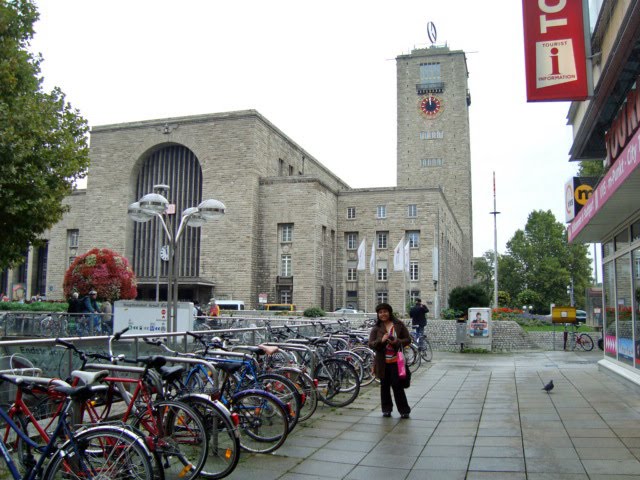
You can see the Stuttgart Hauptbahnhof in my background. It is called in English as Stuttgart Central Station and is written in a short form, Stuttgart Hbf. It is the largest regional and long-distance railway station in Stuttgart, the main node of the Stuttgart S-Bahn network, and, together with the halt at Charlottenplatz, the main node of the Stuttgart Stadtbahn.

ShareThis