Showing posts with label Rome-Italy. Show all posts

Wednesday, August 15, 2012

Gelato in Rome, Italy

It was actually summer season when we visited Rome, Italy last 2010. I mean "we" because I was with a friend from the United States that time. Together we made a tour in Europe and went to the different cities here. I believed Nonna had a great time during  our Europe tour.

It was actually raining in Italy's capital but since it is not so cold, we decided to buy a gelato. What is actually the difference between a gelato and a regular or commercial ice cream? Italians use the word gelato to mean a sweet treat that is served frozen. It is made of milk, cream, sugar and fresh fruits for flavoring. The difference of factory made ice cream compared to gelato is that, the latter has lighter and lower butterfat.

What is your favorite gelato? I love the strawberry flavor. If there is a mango or avocado flavor, I would surely taste it.

A Gelaterie in Rome, Italy. This is where we bought and tasted gelato.

Thursday, December 8, 2011

Trajan's Forum in Rome, Italy

A friend of mine was asking me last time to mention to her if I can find a cheap trip to Rome, Italy. I found one but at the time I called the travel agency, it was already fully booked. Around two weeks ago she told me that she finally booked a trip to Rome. I am very glad for her because she can finally visit the so-called "Eternal City".

I had been to Rome last August 2010. It was only a 4-days visit including the flights and the sightseeing and I still find it too short to see everything. At least, I finally visited and experience the capital city of Italy.

One of the sights we visited was the Trajan's Forum, called in Italian as Foro di Traiano. It is an ancient structure in Rome, Italy and known as the last of the Imperial fora. It was constructed by the architect Apollodorus of Damascus.

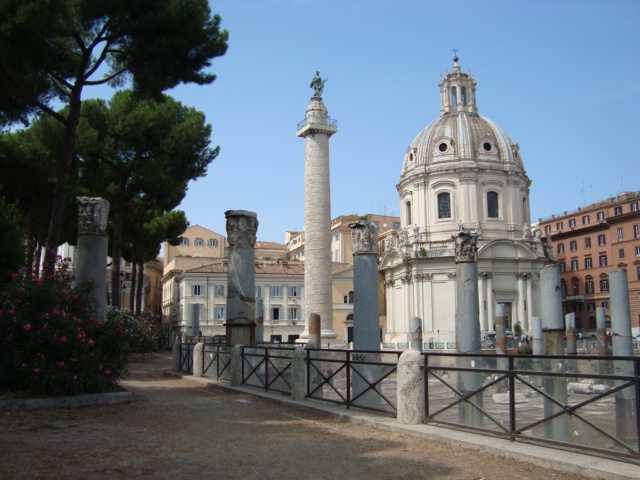
Trajan's Column on the far left of the photo..I took it during our visit last Aug. 2010.

This forum was constructed on the order of Emperor Trajan with the spoils of war from the conquest of Dacia, which ended in 106. The Fasti Ostienses states that the Forum was inaugurated in 112, while Trajan's Column was erected and then inaugurated in 113.

To build this monumental complex, extensive excavations were required: workers eliminated the sides of the Quirinal and Capitoline (Campidoglio) Hills, which closed the valley occupied by the Imperial forums toward the Campus Martius.

the plan of Trajan's Forum.

Monday, October 24, 2011

Sights Not to Miss When Visiting Rome, Italy

There are a lot to see in this capital city of Italy. Rome known as "Eternal City", is the largest city in Italy. It is the famed city of the Roman Empire. It has been the centre of one of the globe's greatest civilizations ever. It has been the millenium-long centre of power, culture and religion that influence the world with its around 2,500 years of existence.

Rome has been one of the most visited cities in Europe. It has two international airports, the Leonardo da Vinci/Fiumicino International Airport and the Ciampino International Airport. The first one is the modern and large main airport of Rome and is well connected to the center of the city by public transportation. The latter is the city's low-cost airline airport usually serving discount airlines in Europe. This is one advantage if you are from Europe because you can always find cheap flights from any European cities to Rome.

There are a lot of sights to see in Rome. Here are a few ones which should be included in your list.

Vatican City

I guess I don't need to elaborate too much about Vatican City. My sister once asked me , if she has the chance to visit Rome, she wants to see and hear the mass presided by the Pope in St. Peter's Basilica. Sad to say, I was not able to hear the mass there and did not have the chance to see the Pope. Maybe in my next visit.

This is the so-called city within the city and known as the world's smallest state. The State of the City of Vatican is located within the city of Rome. The St. Peter's Basilica, the Vatican Gardens, St. Peter's Piazza, Vatican Museum, are among the main sites you need to see and experience in this city. We don't have a lot of time going to Castel Sant'Angelo which is very near this area.

Don't miss to climb up to the cupola of St. Peter's.. From there , you can have a good view of the city.
the obelisk in front of St. Peter's Basilica in Vatican City. One of my travel wishlist was fulfilled after our visit there last August 2010.

The Colosseum

This is also one of the must-see in ancient Rome which is considered to be the most famous of the Roman landmarks . It is also known as the Flavian Amphitheatre which can hold up to 50,000 spectators during those times. Gladiatorial combats and animal fights were ones held in this amphitheatre.

There is entrance when going inside the Colosseo.

I am happy to be there once in my life. I would love to visit this sight again in the future.

The Colosseum when completed measured 48 m high, 188 m in length, and 156 m in width. The wooden arena floor was 86 m by 54 m, and covered by sand.

The Roman Forum

This is one of the reasons why I still want to go back to Rome. Me and my friend Nonna were not able to go inside the Roman Forum, its name in Italian because of limited time. We only had a glance of it from outside.

The Foro Romano, as it is called in Italian, with its hallowed ruins were the most powerful seat of government in the world. It is normally a very interesting historical site. It is also not so crowded than the Colosseum. It is the best way of imagining the splendour and glory of ancient Rome.

The Trevi Fountain

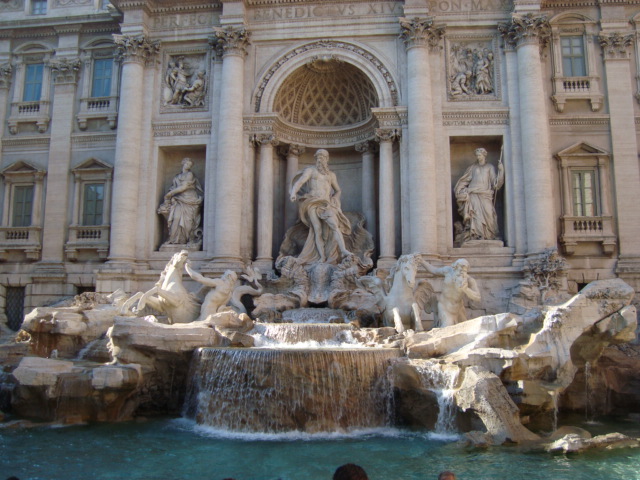
This is considered to be one of the most fountains in the world. The Trevi fountain is the largest Baroque fountain in Rome. It is located near the Spanish Steps, also a famous sight in this city.

During my visit last year, me and my friend threw coins in the fountain. I only threw a euro coin believing that I will be able to visit Rome again in the future. At that time I still did not know about the legend of the "three coins". A current interpretation is that two coins will lead to a new romance and three will ensure either a marriage or divorce. Another reported version of this legend is that it is lucky to throw three coins with one's right hand over one's left shoulder into the Trevi Fountain.
The famous and beautiful Trevi fountain during our visit last August 2010.

The Pantheon

This was once a temple of the gods. Now it is a Catholic Church in Rome. Almost two thousand years after it was built, the Pantheon's dome is still the world's largest unreinforced concrete dome.

The Pantheon was under repair during our visit last summer 2010.

The building is circular with a portico of three ranks of huge granite Corinthian columns (eight in the first rank and two groups of four behind) under a pediment. A rectangular vestibule links the porch to the rotunda, which is under a coffered, concrete dome, with a central opening (oculus) to the sky.

There are still a myriad of sights to see in Rome. The ones I shared here are just a few among the most interesting ones.

Sunday, August 14, 2011

Foro di Traiano, Trajan's Forum in Rome, Italy

I want to go back to Rome again! I will do that by simply looking at the images I took during my visit last August 2010. That to the help of digital camera and photography where we can always travel back in time.

I believed I have not shared yet about Forum Traiani (Latin name), called in English as Trajan's Forum or Foro di Traiano in Italian. This ancient structure in Rome, Italy was said to be constructed by the architect Apollodorus of Damascus.

It is quite interesting seeing these historical remains in Rome. No wonder, it is called "The Grandeur of Rome". What a truly amazing city!


The Basilica Ulpia lies at the north end of the piazza, which was cobbled with rectangular blocks of white marble and decorated by a large equestrian statue of Trajan. You can also see the Trajan's Column on the left side of the image here.

historical ruins of the Trajan's Forum in Rome, Italy. taken during my visit with a friend named Nonna last August 2010.

This forum was constructed on the order of Emperor Trajan with the spoils of war from the conquest of Dacia, which ended in 106. The Fasti Ostienses states that the Forum was inaugurated in 112, while Trajan's Column was erected and then inaugurated in 113.

Wednesday, August 3, 2011

The Arch of Constantine in Rome, Italy

It's been almost a year now since my first visit in Rome, Italy. It was one of the most interesting trip I had in Europe. Rome, the capital city of Italy has a lot to offer to its guests and visitors like me. A three-day visit is not enough to see everything there but I am very happy and contented that I was in Rome once in my life.

One of the sights we visited was the Arch of Constantine, known in Italian as Arco di Costantino. Like the Arch of Triumph in Paris, France or the Siegestor in Munich, Germany, the Arch of Constantine is also a triumphal arch in Rome. It is located between the Colosseum and the Palatine Hill.

taken last August 2010 during my visit together with Nonna, a friend from the U.S.

It was erected to commemorate Constantine I's victory over Maxentius at the Battle of Milvian Bridge on October 28, 312. Dedicated in 315, it is the latest of the existing triumphal arches in Rome, from which it differs by spolia, the extensive re-use of parts of earlier buildings.

The arch is 21 m high, 25.9 m wide and 7.4 m deep. It has three archways, the central one being 11.5 m high and 6.5 m wide, the lateral archways 7.4 m by 3.4 m each. The top (called attic) is brickwork reveted with marble. A staircase formed in the thickness of the arch is entered from a door at some height from the ground, in the end towards the Palatine Hill. wikipedia

Friday, May 27, 2011

The Colosseum in Rome

Let's go back in time and history by visiting the iconic symbol of Imperial Rome. Colosseum or Coliseum is considered to be one of the greatest works of Roman architecture and Roman engineering. I can't imagine how the workers and builders built this magnificent architecture during those times when there were still no modern tools and machines like what we have now. The Colosseum was used for gladiatorial contests and public spectacles during the Roman times. It is considered to be one of the most popular tourists attractions in Rome.

It was truly a wonderful and stunning trip we had in Rome last year especially seeing its historical ruins and architecture.

The Colosseum was built in ca. 70–80 AD. taken during our visit last August 2010.

Monday, April 25, 2011

Monument to Vittorio Emanuele II in Rome, Italy

I always feel happy everytime I remember my past travels. Thanks to the creation of digital cameras where we can always turn back time by viewing over and over again our travel images.

I have here an image of the Monument to Vittorio Emanuele II in Rome, Italy. It is called in Italian as The Monumento Nazionale a Vittorio Emanuele II (National Monument of Victor Emmanuel II) or Altare della Patria (Altar of the Fatherland).

This was taken during my Europe tour with a friend last August 2010.

It is a monument to honour Victor Emmanuel, the first king of a unified Italy, located in Rome, Italy. It occupies a site between the Piazza Venezia and the Capitoline Hill. The monument was designed by Giuseppe Sacconi in 1885; sculpture for it was parceled out to established sculptors all over Italy, such as Angelo Zanelli. It was inaugurated in 1911 and completed in 1935.

The monument, "chopped with terrible brutality into the immensely complicated fabric of the hill", is built of pure white marble from Botticino, Brescia, and features majestic stairways, tall Corinthian columns, fountains, a huge equestrian sculpture of Victor Emmanuel and two statues of the goddess Victoria riding on quadrigas. The structure is 135 m (443 ft) wide and 70 m (230 ft) high. If the quadrigae and winged victories are included, the height is to 81 m (266 ft). credit

Monday, January 17, 2011

Roman Forum in Rome, Italy

I was browsing awhile ago the images I took from Rome, Italy. I had the chance to visit and to experience this city last summer of 2010. It was one of the most interesting and memorable travel I had in Europe. I can't imagine how big I am as I was browsing my images. I guess it is time to also browse for the best diet pills. I am hoping for another trip in Europe this year and hopefully that time, I look slimmer in my images. lol!

Let's go back to the main topic about Roman Forum. It is called in Italian as Foro Romano and in Latin as Forum Romanum. It is located in the small valley between the Palatine and Capitoline Hills. Today, the Forum is a sprawling ruin of architectural fragments and intermittent archeological excavations attracting numerous sightseers. You can see here the statues and monuments commemorating the city's great men.

I can't imagine that I was in this place..that I was in Rome seeing its grandeur and beauty!

Wednesday, January 12, 2011

St. Peter's Basilica in Vatican, Rome, Italy

I felt honored everytime I remember our visit to Rome especially at the St. Peter's Basilica. It was truly an overwhelming feeling. Here are some information and images of this famous religious architecture.

The Papal Basilica of Saint Peter (Latin: Basilica Sancti Petri), officially known in Italian as the Basilica Papale di San Pietro in Vaticano and commonly known as St. Peter's Basilica, is a Late Renaissance church located within the Vatican City. St. Peter's Basilica has the largest interior of any Christian church in the world, holding 60,000 people. It is regarded as one of the holiest Catholic sites. It has been described as "holding a unique position in the Christian world" and as "the greatest of all churches of Christendom".

view of St. Peter's Square and you can see St. Peter's Basilica at the backgound.

In Catholic tradition, the basilica is the burial site of its namesake Saint Peter, who was one of the twelve apostles of Jesus and, according to tradition, first Bishop of Rome and therefore first in the line of the papal succession. Tradition and some historical evidence hold that Saint Peter's tomb is directly below the altar of the basilica. For this reason, many Popes have been interred at St Peter's since the Early Christian period. There has been a church on this site since the 4th century. Construction of the present basilica, over the old Constantinian basilica, began on April 18, 1506 and was completed on November 18, 1626.

the Dome of the Basilica. It was brought to completion by Giacomo della Porta and Fontana.

In Catholic tradition, the basilica is the burial site of its namesake Saint Peter, who was one of the twelve apostles of Jesus and, according to tradition, first Bishop of Rome and therefore first in the line of the papal succession. Tradition and some historical evidence hold that Saint Peter's tomb is directly below the altar of the basilica. For this reason, many Popes have been interred at St Peter's since the Early Christian period. There has been a church on this site since the 4th century. Construction of the present basilica, over the old Constantinian basilica, began on April 18, 1506 and was completed on November 18, 1626.

there were a lot of people during our visit. It took us about two hours to go inside and climb the top of the dome. If you have fear in heights or close space and heart problems, be careful when climbing the 320 steps or you better not.

St. Peter's is famous as a place of pilgrimage, for its liturgical functions and for its historical associations. It is associated with the papacy, with the Counter-reformation and with numerous artists, most significantly Michelangelo. As a work of architecture, it is regarded as the greatest building of its age. Contrary to popular misconception, Saint Peter's is not a cathedral, as it is not the seat of a bishop. It is properly termed a papal basilica. The Basilica of St. John Lateran is the cathedral church of Rome. continue here

Saturday, January 8, 2011

The Spanish Steps in Rome, Italy

When we visited Rome, Italy last August 2010, one of the sights that I wanted to visit was Piazza di Spagna. This is where you see the so-called in English as Spanish Steps. I thought I can only see it in travel books or in the internet, but it was a dream came true seeing it in person.

Spanish steps is a set of steps climbing a steep slope between the Piazza di Spagna at the base and Piazza Trinità dei Monti. It is called Scalinata della Trinità dei Monti in Italian. You can see the church of the Santissima Trinità dei Monti on the top-end of the steps.

Opposite the Spanish Steps is the the narrow Via Condotti, home to many of Rome's designer shops. I am looking for an electronic shop here that sells cheap desktops but I did not find one. Here, you can find famous branded shops like Gucci,Prada, Louis Vuitton, Valentino, Fendi, Cartier, Armani and some other more.

taken during our four-day trip in Rome last August 2010. I love this city! The foregound is a fountain called Fountain of the Old Boat.

In the Piazza at the base is the Early Baroque fountain called Fontana della Barcaccia ("Fountain of the Old Boat"), built in 1627-29 and often credited to Pietro Bernini, father of a more famous son, Gian Lorenzo Bernini, who is recently said to have collaborated on the decoration. The elder Bernini had been the pope's architect for the Acqua Vergine, since 1623. According to an unlikely legend, Pope Urban VIII had the fountain installed after he had been impressed by a boat brought here by a flood of the Tiber river.

Friday, December 10, 2010

Piazza del Popolo in Rome, Italy

This is one of the favorite squares I love in Rome, Italy. Piazza del Popolo commonly known in English as People's Square is one of the largest square in Rome. Historically, it derives from the poplars (populus in Latin, pioppo in Italian) after which the church of Santa Maria del Popolo, in the northeast corner of the piazza, takes its name.

I did remember we had a dinner in one of the cafe restaurants in this square. I ordered a coke that time. After around 15 minutes, the coke still did not arrived. I was done eating and felt very thirsty already. I was quite disappointed with the customer service of that restaurant besides being unfriendly.

I hope to find an image of that restaurant and want to share it here.

the monument from afar are the steps lead from the Piazza del Popolo to the Pincio to the east.

An Egyptian obelisk of Ramesses II from Heliopolis stands in the centre of the Piazza.

The Piazza lies inside the northern gate in the Aurelian Walls, once the Porta Flaminia of ancient Rome, and now called Porta del Popolo. This was the starting point of the Via Flaminia, the road to Ariminum (modern Rimini) and the most important route to the north. At the same time, before the age of railroads, it was the traveller's first view of Rome upon arrival. For centuries, the Piazza del Popolo was a place for public executions, the last of which took place in 1826. wikipedia

Saturday, December 4, 2010

The Spanish Steps in Rome, Italy

Let's go travel Europe again. I am not really very sure if I already shared about one of the sights in Rome, Italy called The Spanish Steps. With the name alone,n you will probably imagine that you will see a lot of stairs here. Yes, it is!

It is called in Italian as Scalinata della Trinità dei Monti. These are set of steps located between the Piazza di Spagna at the base and Piazza Trinità dei Monti in Rome, Italy. It is known to be the widest and longest steps in Europe. The church of Trinità dei Monti is located at the end of these steps. The stairway is said to have 138 steps.

I am happy that I had seen and experience this sight of Rome. Here is an image taken during our visit last August 2010.

The stairway of 138 steps was built with French diplomat Étienne Gueffier’s. A lot of tourist can be seen sitting here especially during summer time.

Saturday, November 27, 2010

The Pantheon in Rome, Italy

I had seen some replicas of the Pantheon building like in Paris, France, in Bavaria, Germany and if I am not mistaken also in Vienna, Austria. This time I had finally seen the Pantheon in Rome, Italy. Pantheon in Greek word means temple. The Pantheon in Rome was commissioned by Marcus Agrippa as a temple to all the gods of Ancient Rome, and rebuilt by Emperor Hadrian in about 126 AD.

During our visit to Rome last August 2010, Pantheon was under repair. You can see the image I took during our visit that time.

The building is circular with a portico of three ranks of huge granite Corinthian columns (eight in the first rank and two groups of four behind) under a pediment opening into the rotunda, under a coffered, concrete dome, with a central opening (oculus) to the sky. Almost two thousand years after it was built, the Pantheon's dome is still the world's largest unreinforced concrete dome. The height to the oculus and the diameter of the interior circle are the same, 43.3 metres (142 ft). A rectangular structure links the portico with the rotunda. It is one of the best preserved of all Roman buildings. It has been in continuous use throughout its history, and since the 7th century, the Pantheon has been used as a Roman Catholic church dedicated to "St. Mary and the Martyrs" but informally known as "Santa Maria Rotonda."

HISTORY:

In the aftermath of the Battle of Actium (31 BC), Marcus Agrippa built and dedicated the original Pantheon during his third consulship (27 BC). Located in the Campus Martius, at the time of its construction, the area of the Pantheon was on the outskirts of Rome, and the area had a rural appearance. Under the Roman Republic the Campus Martius had served as a gathering place for elections and the army. However, under Augustus and the new Principate both were deemed to be unnecessary. The construction of the Pantheon was part of a program of construction that was undertaken by Augustus Caesar and his supporters. They built more than twenty structures on the Campus Martius, including the Baths of Agrippa and the Saepta Julia. It had long been thought that current building was built by Agrippa, with later alterations undertaken, and this was in part due to the inscription on the front of the temple. However, archaeological excavations have shown that the Pantheon of Agrippa had been completely destroyed, and Emperor Hadrian was probably responsible for rebuilding the Pantheon on the site of Agrippa's original temple. more infos here

Wednesday, November 24, 2010

The Trevi Fountain in Rome. Italy

It is always nice taking back time to return to the places we traveled. Thanks to the digital technology where we can already take digital images through our camera. I don't remember having a nodular acne during our visit to Rome, Italy last August of this year. One of the sights we visited was the famous fountain of Trevi. I had already seen one of its replica in Caesars Palace in Las Vegas Strip, Paradise in Nevada. It has always been my dream to see Trevi Fountain and I am very thankful that I had finally seen it in person.

Here is an image I took during our visit to Rome last August 2010.

Friday, November 19, 2010

The Arch of Constantine in Rome, Italy

The Arch of Constantine in Rome, Italy looks like the Arch of Triumph (Arc de Triomphe) in Paris, France, the Siegestor in Munich, Germany and there are still a lot of structure around the world that looks like this. It was built to commemorate Constantine I's victory over Maxentius at the Battle of Milvian Bridge on October 28, 312.

The arch is 21 m high, 25.9 m wide and 7.4 m deep. It has three archways, the central one being 11.5 m high and 6.5 m wide, the lateral archways 7.4 m by 3.4 m each. The top (called attic) is brickwork reveted with marble. A staircase formed in the thickness of the arch is entered from a door at some height from the ground, in the end towards the Palatine Hill.

taken during our trip in Rome, Italy last August 2010

Friday, November 12, 2010

The Trevi Fountain in Rome, Italy

Let's go travel in Europe again! How would you love to visit Rome and see one of the famous fountains in the world? The Trevi Fountain, called in Italian as Fontana de Trevi was created by Bernini in 1641 and was continued by architect Salvi in 1735 under Pope Clement XII.

There is a legend about this fountain that says, whoever drinks its water or throws a coin in it will surely return to Rome. That is also the reason why I threw a coin during our visit last August 11-14, 2010. The Trevi Fountain is also known for its excellent water. It is also the largest baroque fountain in Rome.

Here are some images I took during our visit last August 2010.

a detail of the Fountain.

The Trevi Fountain is said to measure 25.9 meters (85 feet) high and 19.8 meters (65 feet) wide.

Monday, October 18, 2010

Monument of Victor Emmanuel II in Rome, Italy

This is the Monument of Victor Emmanuel II (Monumento Nazionale a Vittorio Emanuele II in Italian). It is a monument in honor of Victor Emmanuel, the first king of a unified Italy, located in Rome, Italy. It was designed by Giuseppe Sacconi in 1885 and known to be completed in 1935. It is made of pure white marble from Botticino, Brescia.

This is one of the amazing architectures that I love in Rome. I wish I went up to the roof to see the whole of Rome but we don't have much time during our four days visit last August of this year.
taken during our visit last August 2010

The monument holds the Tomb of the Unknown Soldier with an eternal flame, built under the statue of Italy after World War I following an idea of General Giulio Douhet. The body of the unknown soldier was chosen on October 26, 1921 from amongst 11 unknown remains by Maria Bergamas, a woman from Gradisca d'Isonzo whose only child was killed during World War I. Her son's body was never recovered. The selected unknown was transferred from Aquileia, where the ceremony with Bergamas had taken place to Rome and buried in a state funeral on November 4, 1921.

Thursday, September 16, 2010

Piazza del Popolo in Rome, Italy

I want to share more images taken during our Europe tour last month but I just don´t find enough time to do it. Please be patient for now because I will slowly share some snapshots from our travel. Let´s go back to Rome this time. I already posted some images last month and now I am sharing another one again. This is one of the famous square in Rome, the Piazza del Popolo.

Piazza del Popolo is a large square in Rome, Italy. The name in modern Italian literally means "People's Square", but historically it derives from the poplars (populus in Latin, pioppo in Italian) after which the church of Santa Maria del Popolo, in the northeast corner of the piazza, takes its name.

The Piazza lies inside the northern gate in the Aurelian Walls, once the Porta Flaminia of ancient Rome, and now called Porta del Popolo. This was the starting point of the Via Flaminia, the road to Ariminum (modern Rimini) and the most important route to the north. At the same time, before the age of railroads, it was the traveller's first view of Rome upon arrival. For centuries, the Piazza del Popolo was a place for public executions, the last of which took place in 1826. more infos here


Here is an image I personally took during our visit in Rome last August 2010.

An Egyptian obelisk of Ramesses II from Heliopolis stands in the centre of the Piazza.

Friday, September 10, 2010

Driving in Rome, Italy

I just wanted to share about an experience that me and my friend had during our trip to Rome, Italy last month. I find it there quite a chaotic place especially the driving on the streets of Rome. We arrived at night in Rome Fiumicino airport that time. After getting our luggage, we tried to find a means of transportation or shuttle going to our hotel. Some taxi drivers are offering very expensive charges. We finally found a shuttle who drove us to our hotel. It only cost 15.00 Euros per person which is quite fair compared to taxis who are charging for up to 100.00 Euros. The driver was always telephoning while driving. It was quite scary because we were on the highway and it was night time. Sometimes the driver is already out on the street marking. As we passed-by at the center of Rome and the traffic light happened to get red, he still continue driving even there were passers-by on the middle of the road. I don't know what kind of car insurance he has that he can do such kind of driving. It was truly very scary. For a driver who has a lot of accidents, finding cheap car insurance rates is quite difficult. I can't imagine how many accidents did that driver had with that kind of driving he has. I am just thankful that we arrived in our hotel safely and most of all we came back home whole and safe. Here is an image I took at the streets of Rome. This was taken some meters away from Colosseum. If you are driving to Rome, be very careful and drive safely always.

an image I took during our visit to Rome, Italy last month.

Saturday, August 28, 2010

The Colosseum in Rome, Italy

Hello folks! I am slowly back in the blogosphere. The German-Pinay blogger is finally done with her Europe tour. It was quite a tiring but very amazing and interesting adventure. To start my post, I am sharing an image of the Colosseum in Rome, Italy. The Colosseo as it is called in Italian language, is an elliptical amphitheatre in the center of the city of Rome, Italy. It is considered to be the largest ever built in the Roman Empire and considered to be one of the greatest works of Roman architecture and engineering. It is located east of the Roman Forum.

I just want to remind you that I am not a professional photographer. I just love to take pictures of anything that catches my camera especially the interesting places I had been too. Here is an image of the Colosseum or Colosseo taken during our four-day adventure from August 11-14, 2010. More images to come next time.

The Colosseum or, The Coliseum, originally the Flavian Amphitheatre. Its construction started between 70 and 72 AD under the emperor Vespasian and was completed in 80 AD under Titus, with further modifications being made during Domitian's reign (81–96).

ShareThis